

Banking on resilience for sex workers: What you can learn from India’s USHA co-operative

👉 Read in: Español l Português l Français
Where would you keep your money if banks refused to serve you?
Before USHA existed, many sex workers in Sonagachi—the “red light district” of Kolkata, India—kept their money with pimps and madams. But often, they were cheated out of those funds. At other times, local police would extort money from them.
As a result, many sex workers chose to spend their money as soon as they earned it, leaving them vulnerable to unforeseen expenses related to illness, marriage or deaths in their families. When this happened, their choices were stacked against them: accept predatory loans from moneylenders or accept risky work to make ends meet.
It wasn’t until the early 1990s, when peer-led sexual health programs got underway that Sonagachi’s sex workers gathered to discuss how to solve their problem of financial precarity.
In June 1995, the USHA Multipurpose Cooperative Society was founded with the mission of providing financial security to sex workers and achieving educational and career-building opportunities for the children of sex workers.
As the first-ever financial cooperative run by sex workers for sex workers in South Asia, USHA is a trailblazer. Its community-driven approach to financial innovation and resilience is the key to its success and sustainability.
At a time when interest in alternative financial models is growing among civil society organizations, there is much to learn from these sex workers who fund themselves. In this blog, we outline three key takeaways from USHA’s story to apply to your own context.1

1. Pooling financial resources helps everyone stay more resilient
From humble beginnings—starting with just 13 members and the equivalent of USD $360—USHA has grown into the largest sex worker-led financial cooperative in South Asia. Its nearly 40,0000 members are achieving economic independence through a wide range of savings, loans and livelihoods services.
So, what does it take to turn previously unimaginable dreams for sex workers and their families into a reality?
Two of USHA’s core services are low-interest loans and high-interest savings accounts for its members.
- Roughly 4,000–5,000 sex workers receive loans each year. USHA also offers microcredit schemes and education loans of up to (the equivalent of) USD $3,600. Approximately 40% of the loans are used for the education of members' children, according to USHA.
- Savings services include flexible accounts, along with daily money collection, fixed deposits, and a tie-in product with the Life Insurance Corporation of India.3
Today, USHA has an annual financial turnover of about USD $2.3 million. The impact of its work on the community’s individual and collective resilience is multifaceted. Not only are members supported to build more responsible saving and spending habits, but it has also enabled individual sex workers to create a reserve of earnings to fall back on when crisis strikes.
At a community level, sex workers are no longer at the mercy of predatory money lenders, so indebtedness and debt bondage have decreased. Plus, many children educated with USHA’s support have gone on to find gainful employment in a variety of sectors, including important government positions.
2. Financial accountability and movement-building go hand in hand
At the centre of USHA’s operations is a democratic model of governance consisting of nine elected board members (all sex workers). It employs another 47 people, two-thirds of whom are women. Older sex workers and the daughters of sex workers are given priority in recruitment.
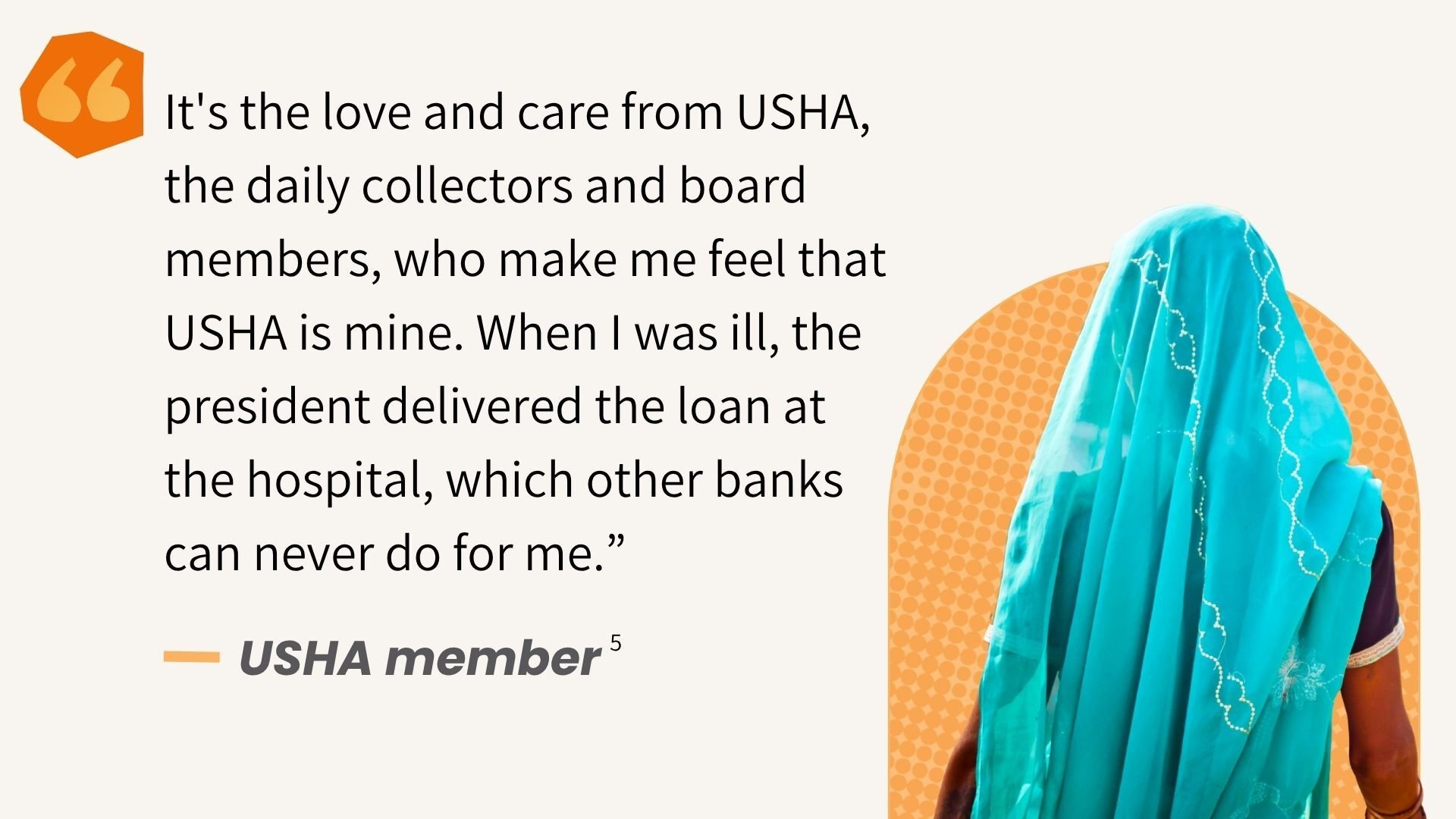
The organization’s daily collection system makes financial transactions efficient for sex workers while also creating jobs for collectors. This service has boosted membership (increasing the amount of money deposited five-fold in one year) and stewarded feelings of ownership and empowerment among people working as collectors.4
As feminist resourcing expert Tenzin Dolker has pointed out, “Mobilizing resources is itself movement-building: expanding a base of supporters, activating movement members, and ideally sustaining long-term relationships.”
It wasn’t always easy, however. It took a while to build legal recognition with authorities, as well as trust and membership within the community. People didn’t understand what the cooperative offered at first. However, by 2022, USHA had coalecsed into a powerful national voice; the organization played a critical role in a landmark Supreme Court judgement recognizing sex work as a profession.
And the financial results speak for themselves. USHA’s loan recovery rate is higher than 90%—an incredibly impressive rate (one of the best in the state of West Bengal) that underscores the trust and accountability between the members who make up the institution.
3. Lead with a spirit of innovation that responds to your community’s needs
USHA’s leadership in the movement for sex workers’ rights and autonomy is unique, characterized by innovation, experimentation and deep commitment to providing services that respond to its members’ needs.
This spirit has seen the cooperative evolve from a savings-and-loans organization to one that carries out robust programming, including income-generating business activities and alternative livelihoods. Underpinned by the organization’s mission of self-determination for sex workers, these activities usually combine income generation with social purpose.
For example, one business activity involves the social marketing of condoms, combining income-generation with safe-sex advocacy. Another involves sanitary napkin distribution (and, in time, plans for in-house production), thereby improving workers’ menstrual health while creating employment. Other endeavours include traditional kantha embroidery, selling everyday items, as well as agriculture and fish farming in some regions (this receives some government support). Sex workers can also come to USHA for vocational training as beauticians, drivers, electricians, carpenters and in computer operations.
Today about 80% of USHA’s profits come from these business activities. Another 10% comes from loan interest and another 10% comes from foreign funding institutions that are supporting specific projects. Continuing to make the business activities profitable is a key priority.
!["I used to keep my money under my mattress or give it to my madam. But many times, she would refuse to give [it] back to me... Now I have a bank account, my own savings and I have taken loans twice to send my brother to college and then to build a house." -Bharati, former USHA president](https://www.springstrategies.org/hs-fs/hubfs/Before%20USHA%2c%20I%20used%20to%20keep%20my%20money%20under%20my%20mattress%20or%20give%20it%20to%20my%20madam.jpg?width=1920&height=1080&name=Before%20USHA%2c%20I%20used%20to%20keep%20my%20money%20under%20my%20mattress%20or%20give%20it%20to%20my%20madam.jpg)
What’s next?
USHA’s evolution represents a bold claim to dignity, autonomy, and rights. Through its efforts, sex workers gained financial inclusion, social recognition, and access to education and safer working conditions.
Looking ahead, USHA plans to take its work to scale with a “Dream-building Project”. This project would help even more sex workers achieve their life’s dreams through self-help savings groups. In particular, USHA hopes to support sex workers over 45 years old to transition into other income generation activities as well—child care crèches is one key opportunity they have identified.
Knowing that the inclusion of sex workers in a sector creates positive ripple effects, USHA is poised to make another big investment: healthcare. Health services for sex workers currently fall mainly into HIV/AIDS treatment and prevention programs, but the workers (like anyone else) have other healthcare concerns that come up from time to time. Seeing this gap, USHA aspires to develop a comprehensive healthcare service for its community members.
As always, a recognition of the whole person, their needs and dreams is at the heart of USHA’s services for sex workers in the years to come.
Notes
- This blog is based on a conversation with Bharati Dey, Santanu Chatterjee, and Rahul Das from USHA, who joined Spring, Human Rights Funders Network, Solidaire and a number of global social and climate justice funders for a discussion on how the philanthropic sector can respond to a post-aid world and nurture resilience financial models for civil society organizations. To learn more about our public-facing 2025 conversation series on this topic, visit our Reimagining Resilience Library.
- Quote from an USHA member (UNFPA).
- Quote from an USHA member (UNFPA).
- Quote from an USHA member (UNFPA).
- Quote from an USHA member (UNFPA).
- Quote from Bharati Dey (NSWP).