

The FIRE Advantage: How organizations weathered the funding disruptions of 2025
The dismantling of USAID in 2025, alongside several ongoing and abrupt shifts in philanthropy created a "perfect storm" for social and climate justice organizations. Many organizations faced catastrophic budget collapses. So, what did they do next?
We wanted to know how the leaders of these organizations coping, one year later. Our Financial Innovation and Resilience (FIRE) program was designed to equip teams to navigate volatility while maintaining financial health. How did it actually help during this crisis?
We surveyed dozens of FIRE program alumni to understand how they were (and are) weathering the ongoing storm. Their reflections offer an unvarnished look at the crisis and the emerging transition we see in how groups are reimagining institutional resilience. Looking back, 2025 served as a real-world “stress test” for how these leaders are applying the mindset shifts, practices and strategies from the program.
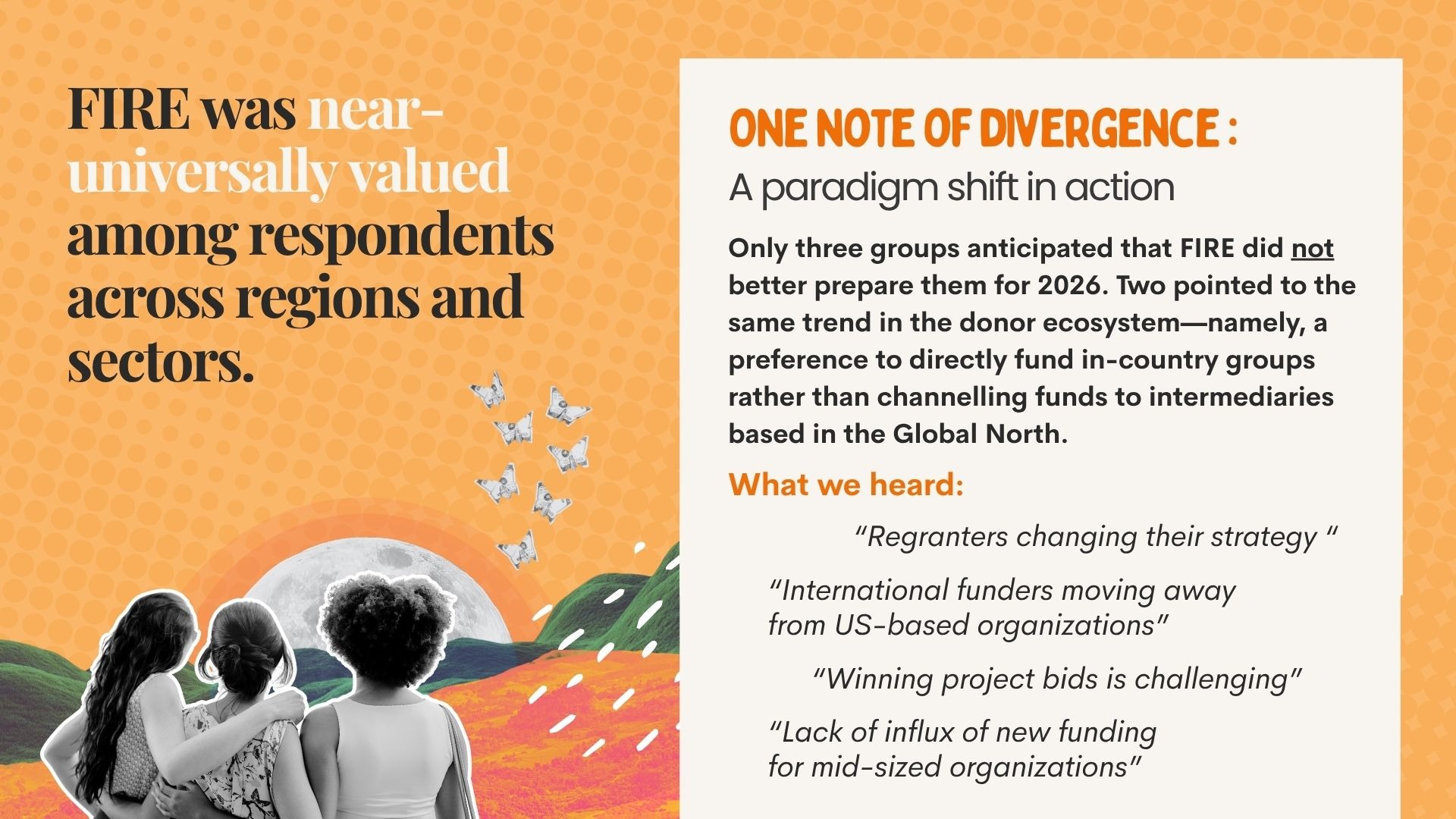
Teams that went through FIRE demonstrate a clear edge in navigating choppy waters. They are increasingly making strategic budgeting choices, exploring non-grant income opportunities, confidently making bold funding asks that nurture their financial sustainability, and joining forces in impressively networked resource mobilization strategies.
.png?width=1920&height=1080&name=FIRE%20Alumni%20Survey%20Data%20-%20Internal%20Report%20(4).png)
The respondents
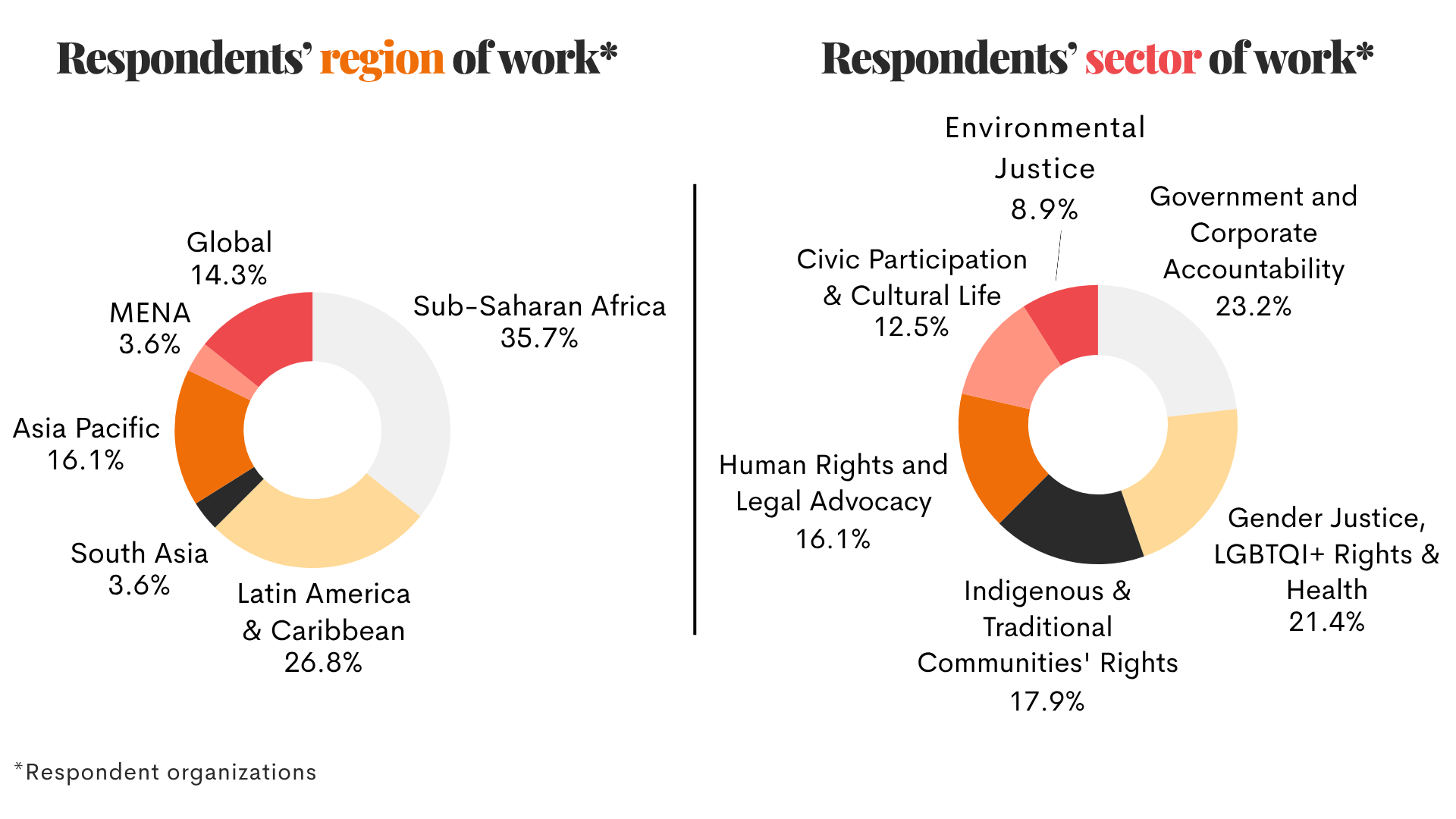
We sent our survey to 682 organizational leaders who have participated in the FIRE program since 2020. The survey was distributed in English, Spanish, Portuguese and Bahasa Indonesia. A total of 69 alumni responded (a 10% response rate), representing 56 organizations in 26 countries and a variety of sectors. The majority of surveys were completed mainly by Executive Directors and Finance Managers.
Takeaway #1: 2025 was especially hard, but FIRE prepared alumni to meet the moment
Three-quarters of respondents agreed that 2025 was an especially difficult year. Looking ahead, most FIRE alumni also expect 2026 to be especially difficult (though slightly fewer at 65%), while 16% believe the rest of 2026 will be less hard).
The two most commonly cited difficulties were funding cliffs (shifting funder priorities, foundations closing down and sudden donor withdrawals like USAID) and capacity gaps (such as not knowing how to fundraise outside of grants, challenges with local fundraising, recovering core costs and financial policy development).
Still, seven-in-ten respondents believed that FIRE better prepared them for 2025. Despite their challenges, FIRE alumni were able to take steps toward resilience: increasingly making strategic budgeting choices, exploring non-grant income opportunities, confidently making bold funding asks that nurture their financial sustainability, and joining forces in impressively networked resource mobilization strategies.
Takeaway #2: Groups are pivoting with multi-faceted resilience strategies
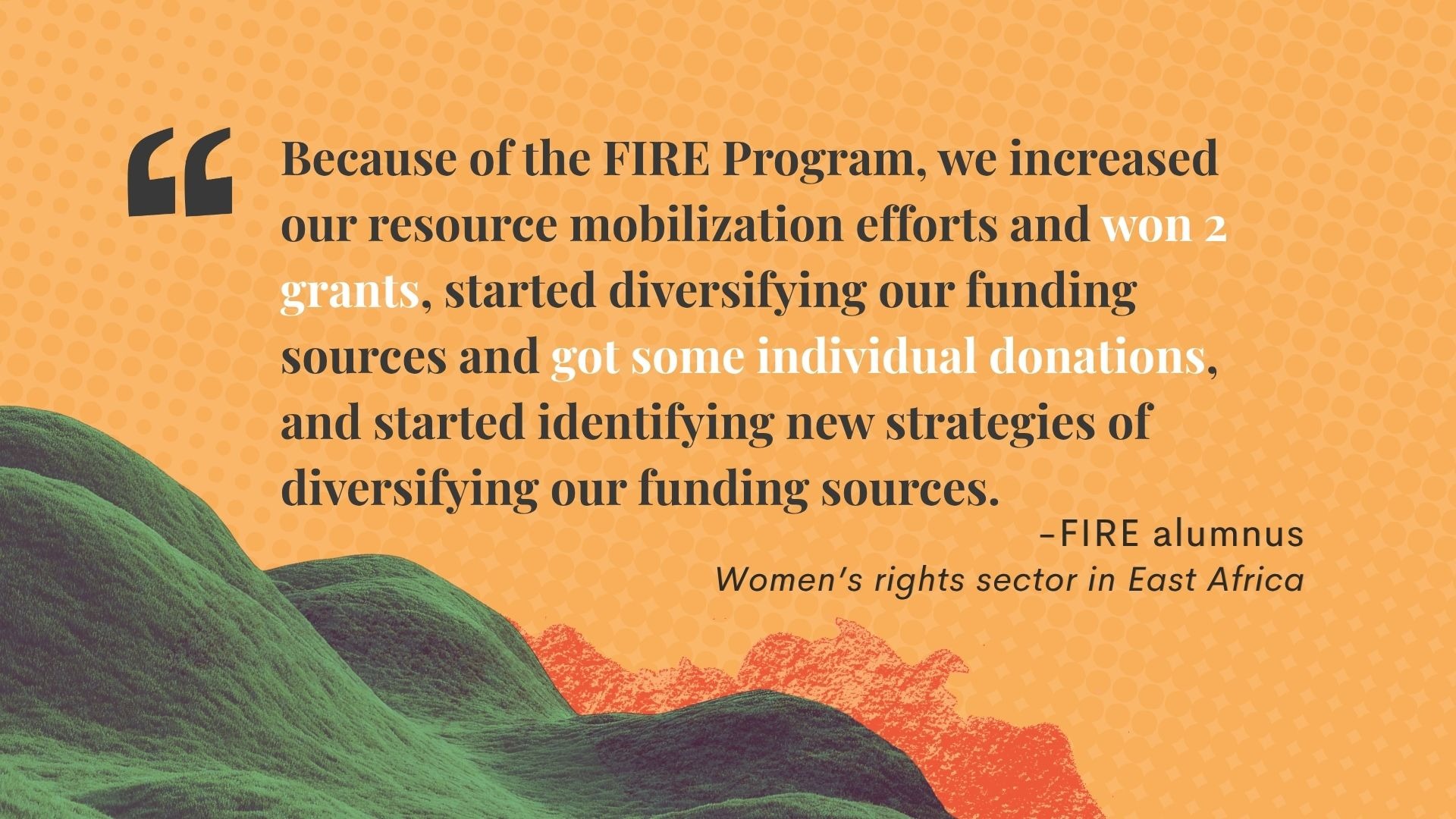
Looking ahead, an overwhelming 96% of organizations feel that, after FIRE, they are more confident about facing the challenges of 2026. Respondents reported positive development around their confidence, relationships, communications, financial health monitoring, funding diversification, capital reserves and innovation.
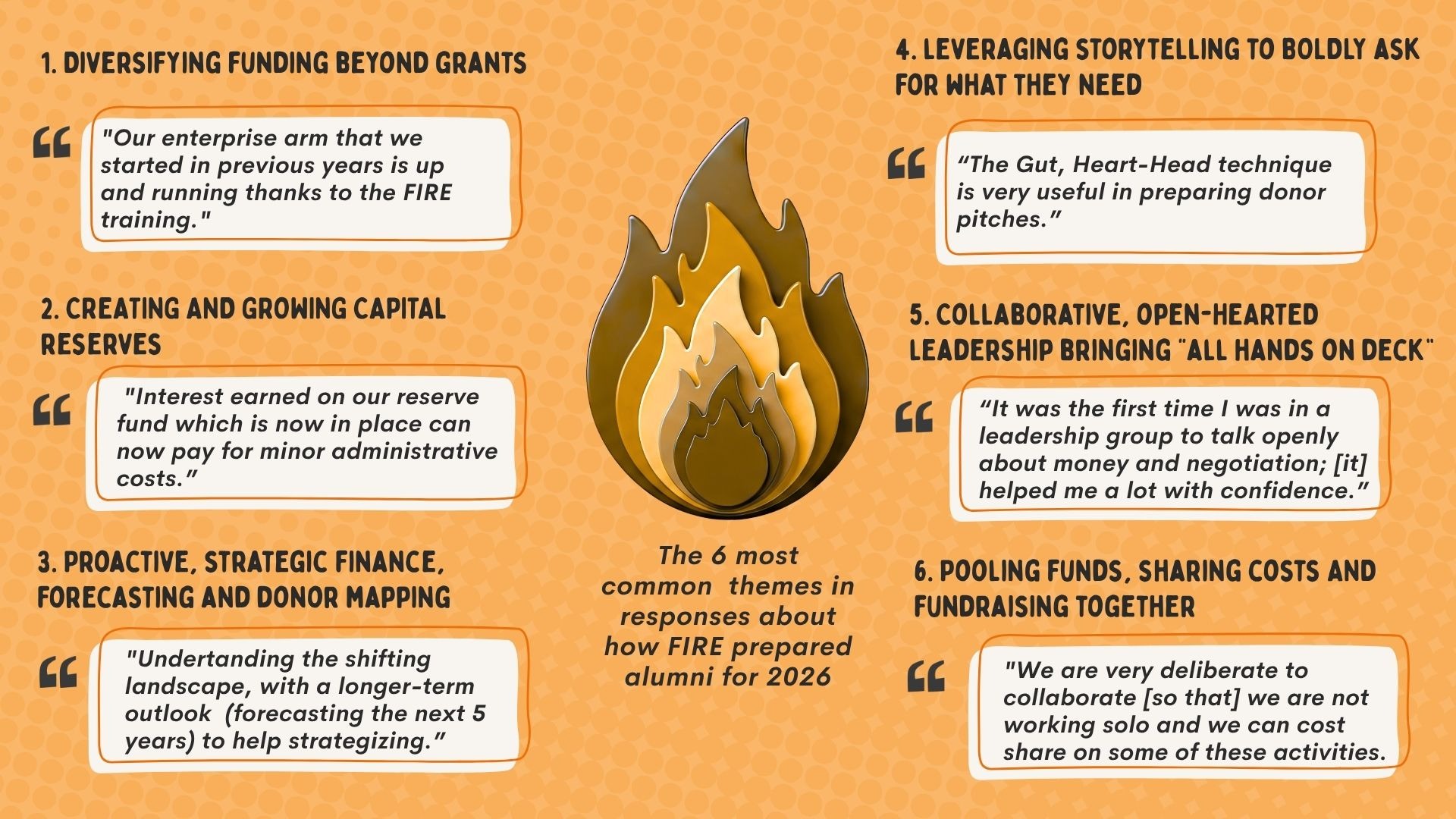
Alumni report mobilizing resources more strategically: boldly asking funders to cover core costs, engaging long-term forecasting, developing robust policies, breaking down siloes to approach finance as a team, and leveraging more compelling donor communications. Among all FIRE tools and strategies, action related to building reserves was most pronounced. More than one-in-four alumni mentioned building and managing reserves to cover core costs and weather periods of uncertainty.
Takeaway #3: Innovation and movement generosity are steering toward a new horizon
In a world of shrinking resources, many organizations are choosing solidarity over competition. There was a notable uptake of strategies we categorize as "movement generosity" and “networked resilience”. Examples we heard included joint fundraising initiatives, cost-sharing within organizational areas, and pooling resources with peer organizations to ensure mutual survival.
A quarter (25%) of respondents also told us about innovative, non-grant resource mobilization strategies they are pursuing. This includes social enterprise models, earned income consultancies, individual donor strategies, joint ventures and other non-grant income.
These are exciting innovations on their journeys away from models built on grant dependency to ones built on innovation and sustainability. While these resilience journeys are ongoing, this data is a silver lining in the midst of a tumultuous time.
A final word to funders
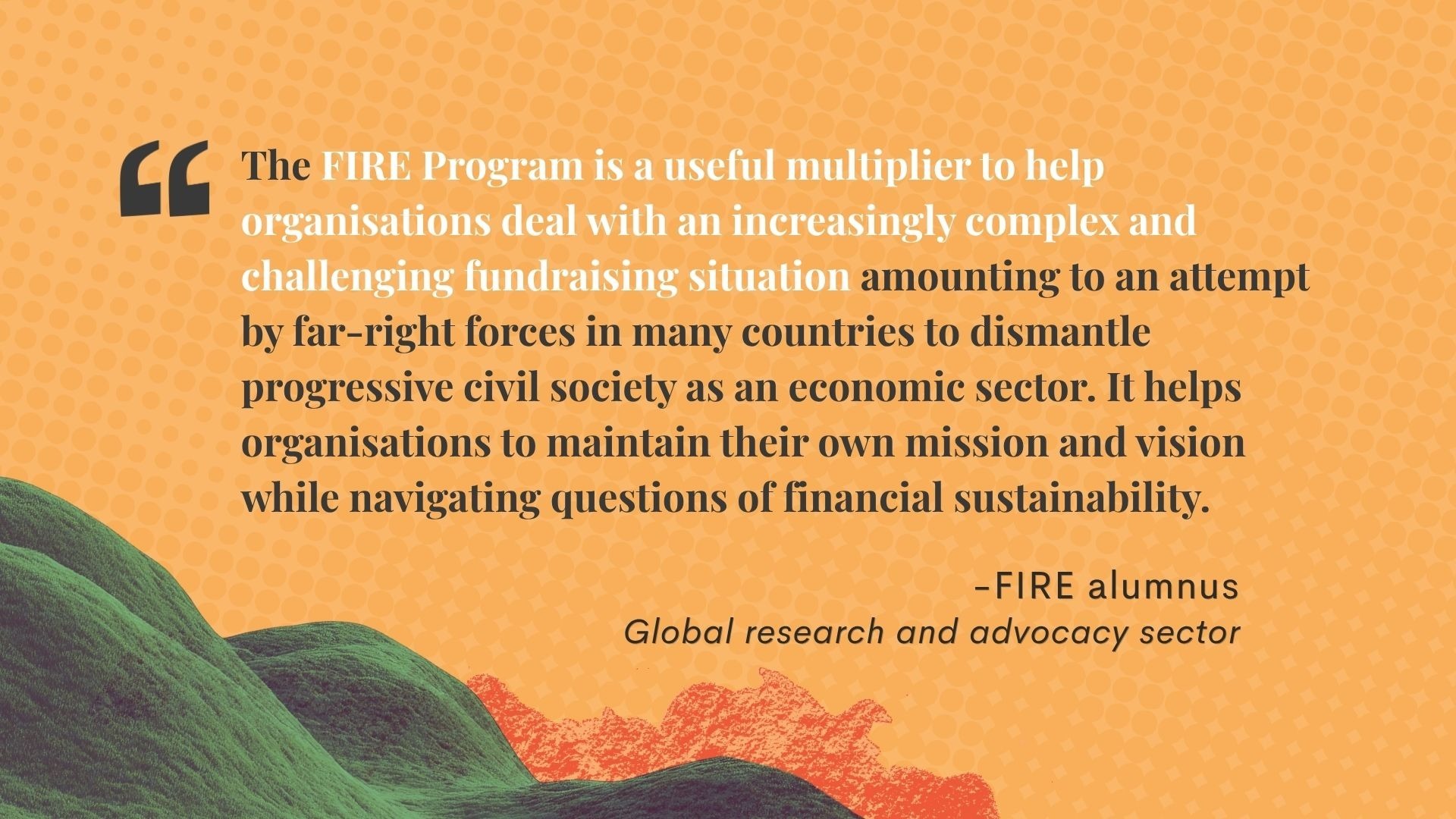
For funders, the ultimate takeaway comes in the words of respondents themselves, who shared what they wish funders would know and act on: in today's era, a resilient civil society requires transformational partnerships that fund the "unsexy" essentials: core operations and capacity strengthening—including to explore grant alternatives. As one respondent put it, “Give more, give unrestricted, and where you can't give unrestricted, offer additional organisational support/resilience funding and a solid overhead.”
As a capacity-strengthening organization, our bird’s-eye view is clear: the most successful missions aren't fueled by money alone, but by the relationships and resilience of the teams, organizations, funders and networks behind them.
As one activist organization from Latin America put it, "FIRE is an investment in strengthening the institutional capacity and financial resilience of civil society. [M]ore autonomous, strategic organizations [are] better prepared to sustain lasting transformations in their territories".
🔥
📙 Read the full report
You can read or download the full report here.
🔥 Financial Innovation and Resilience (FIRE) Essentials
Join Spring’s FIRE Essentials program with your team this year and start designing your organizational Action Plan. You’ll learn how to proactively respond to your funding landscape, mobilize diverse resources, leverage audience-centred communications, and work with a budgeting strategy that will help you recover core costs—say goodbye to the “starvation cycle”!
🎧 Listen to the FIRE podcast: “Grit, Mission & Numbers”
Tune into “Grit, Mission & Numbers”, hosted by FIRE Lead Lucia Carrasco, and available in English, French, Spanish and Portuguese. Each episode, Lucía sits down with financial leaders in civil society organizations to hear what they’re actually trying—building capital reserves, rebounding from catastrophic funding losses, scaling sustainably, and everything in between.