

More than money: What Fondo Semillas’ community fundraising makes possible
👉 Read in: Español l Português l Français
It started with 20 people and a simple idea: that ordinary people could fund local causes and be part of a broader feminist transformation.
Since the 1990s, feminist women’s fund Fondo Semillas has nurtured a committed community of individual donors in Mexico through direct donations, cause-related products, digital campaigns, events, and crowdfunding partnerships. Together, they are creating better lives for girls, women, trans and intersex peoples in Mexico.
Currently, Fondo Semillas funding comes from a variety of sources, including international grants. In turn, the fund supports 219 local grassroots organizations, collectives and movements in Mexico with about US$5.5 million total in grants. Individual giving accounts for a small proportion of these overall funds, but a small pot of money can make a huge difference.
By taking a closer look at lessons from Fondo Semillas’ experience, through the eyes of Donor Community Manager, Ana Laura Godínez,1 organizations around the world (and the funders supporting them) can learn more about building local cultures of philanthropy in the Global South.
Mobilizing “financial activists” and creating a community

When you compare the amount of money Fondo Semillas has raised from individual donors compared to institutional grants, it seems like a lot of work and effort for a small purse of money. Last year, its donor community raised US$256,000, about 3% of its total income of US$8.8 million.
But it’s not just about the money. It’s about hope, trust and a collective vision of social change. There’s power in how you raise the money.
Ana encourages donors to see their giving as a form of financial activism. Some activists can put their bodies on the line to build a better world, while others can fund them to continue that work.
Community fundraising offers three key benefits that strengthen Fondo Semillas’ financial resilience:
- The most flexible funding the organization has: No contracts, no strings attached—just citizens who want to make a difference and who trust in feminist causes. Money from these donations can be saved over time, banked for emergencies or special projects.
- Visibility and credibility: The public invitation to support the fund's work has opened doors to new partnerships with companies, media, artists, and influencers. Through this profile-building and engagement, the team is changing narratives about what it means to support feminist movements.
-
Political support for social change: Donors become part of a community driving local feminist agendas forward. They are ready to answer calls to action and in it for the long-haul.
“Food, water, and medicine arrived quickly from across the country,” says Ana. “However, we knew that recovery requires much more than emergency aid. Communities need resources to rebuild their lives and homes.”
The organization set a goal to raise $US1 million to support 20 local organizations. By December, they had secured 80% of the funds from institutions and corporations, leaving a 20% shortfall.
“However, thanks to our donor community—people who had been giving consistently over the years—we reached our goal. That’s the power of community,” she says.
Investing in audience research creates space for change
Ana joined the Fondo Semillas team about six years ago, inheriting the responsibility of nurturing this committed group of supporters, some of whom had been with the organization for almost 30 years.
“My first goal was to strengthen our internal structure and grow this community, especially after Fondo Semillas made the important decision to name itself a feminist fund and not just a women's fund,” she explains. While a political milestone, declaring themselves feminist presented a fundraising challenge.
Successful community fundraising hinges on effective communications and digital engagement. Not being able to connect with the target audience is one of the key risks of this tactic. So when Fondo Semillas realized that their social media channels were reaching mainly activists and people already supportive of their cause—but the majority of these people weren’t donating, they knew they needed to do something differently.
To raise funds in a country where people are sceptical of charitable giving (due to scams, corruption and economic instability) and where traditional media outlets and social media discourse are often hostile to feminist causes, Fondo Semillas needed to take a closer look at its narrative models.
In 2022, with support from Prospera and Solidarity Fund (a Mama Cash initiative), they undertook audience research. Surveys and focus groups allowed them to dive deep into what motivated donors in Mexico, what their interests were, and how they wanted to engage with the organization.
The research results showed that to reach new people who might support their work but didn’t necessarily identify as feminists, they needed to create simpler, more inviting narratives.
New narratives inspire people outside the feminist bubble to join the cause

Determined to reach mainstream audiences, Ana and team unlearned certain communications conventions prominent in the feminist sector—like the combative narratives prominent in the feminist space and the technical jargon used by many non-governmental organizations.
“We asked ourselves, how could we use our mobilization strategy to propose a new narrative to counter the negative discourse surrounding feminism?” Ana explains.
This meant telling stories about gender-based rights in a more human way. How could they relate to their audiences as mothers worried about their children, for example? What would it look like to talk about shared concerns about the cost of living, rather than the fight to topple capitalism as a whole?
The effect of these narrative changes was huge.
Fondo Semillas raised a total of $80,000 in just two years—more than doubling their initial $30,000 investment in the project.
“Our donor community grew from 110 in 2019 to over 500 individuals today—a growth rate of over 400%,” says Ana, breaking down the numbers for us. Overall, more than 2,000 people have donated at least once since 2019 and roughly half of them stay engaged long-term.
Funders can play an important enabling role

Individual giving tends to require a significant investment in institutional infrastructure, such as databases to track and communicate with donors, administrative reporting and engagement tactics to get your message out there. It can be daunting for organizations to get started.
For example, the donor team at Fondo Semillas must keep pace with the stringency of Mexican regulations surrounding donations (designed to stop money laundering). They must collect tax identification numbers for (and issue receipts) to every donor, as well as report every donation above US$5,000 to the government.
Funders can support this work by helping organizations invest in their communications. The most strategic kind of support, says Ana, looks like:
- Quality, unrestricted funding that allows for innovation and special projects.
- Support beyond money for critical services like digital marketing, customer relationship management tools and memberships or subscription services.
- A willingness to take risks alongside grantees. Change is never a straight path, says Ana. It means a willingness to experiment, test, make mistakes, learn and grow. Funders need the trust and courage to be on that journey with grantees.
What’s next for Fondo Semillas?
Looking ahead, the team hopes to continue sharing their learnings with local organizations. They also want to participate in more fundraising learning exchanges, exploring different philanthropic cultures and building collective knowledge with sister funds in Latin America.
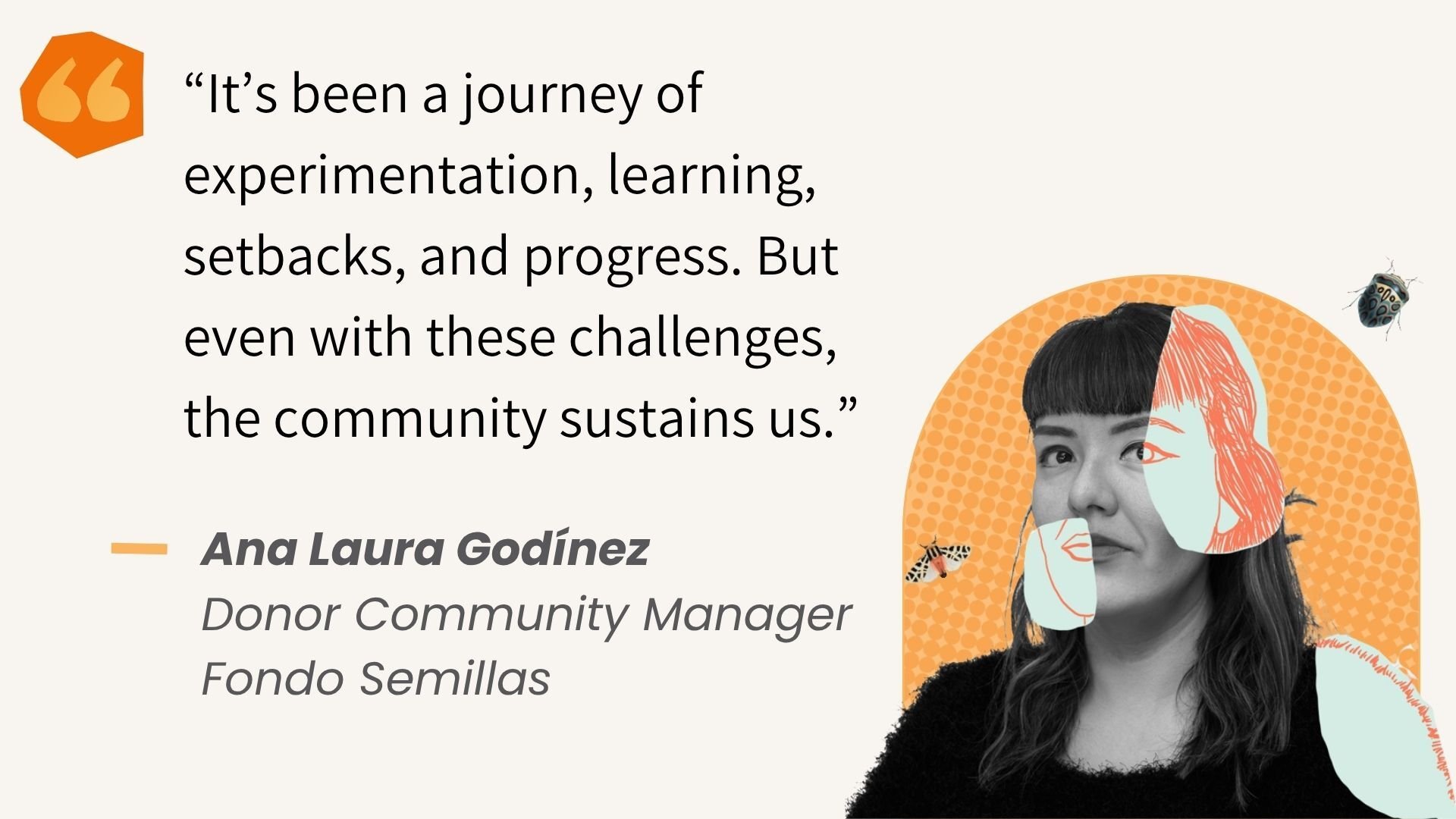
“We would love to have more spaces and resources to keep these exchanges going in a more consistent and structured way, year after year,” hopes Ana. “Learning from each other is how we grow, support one another, and find new ways to innovate.”
While the organization hopes to increase its locally donated pool of flexible funds, including mobilizing high-net worth individuals, it doesn't want to expand the size of the fundraising team.
“That’s why we want to work with donors and partners that can help us evaluate and strengthen our individual donor strategy, and to understand how far we can take it in the next five years,” she adds.
Today, as Fondo Semillas reflects on its journey, it's celebrating everything that it has built with its community.
Notes
- This blog is based on conversations with Ana Laura Godínez of Fondo Semillas in September 2025, which was jointly hosted by Spring, Human Rights Funders Network, and Solidaire. It was attended by a number of global social and climate justice funders for a discussion on how the philanthropic sector can respond to a post-aid world and nurture resilience financial models for civil society organizations. To learn more about our public-facing 2025 conversation series on this topic, visit our Reimagining Resilience Library.