

The power of “patient capital”: Alfanar on how to make your organization impact investment-ready

Is it possible to scale sustainable businesses and change the way money flows on this planet?
The venture philanthropists with a purpose at Alfanar are doing just that—and transforming lives across the Arab world in the process.
Started in 2004, Alfanar is the first venture philanthropy organization in the Arab region. It funds, supports and scales high-impact social enterprises tackling the region’s most urgent challenges.
“The theme in our part of the world is that there is a lot of potential,” says Mohammed Al Radi, Impact Manager at Alfanar, who sat down with us about their field-building work in this area.
Putting the logic of business to work for social good requires a combination of what Alfanar calls “patient capital” (long-term, flexible funding) and hands-on support.
Especially now, in an era of intersecting crises and landscape-shifting declines in foreign aid, philanthropists need to “make their funding count,” he says. Funders seeking to help organizations get ready to access a wider pool of funding through impact investing must provide patient capital and support the capacities of the organizations, not just projects.
Impacting investing and venture philanthropy—what’s the difference?
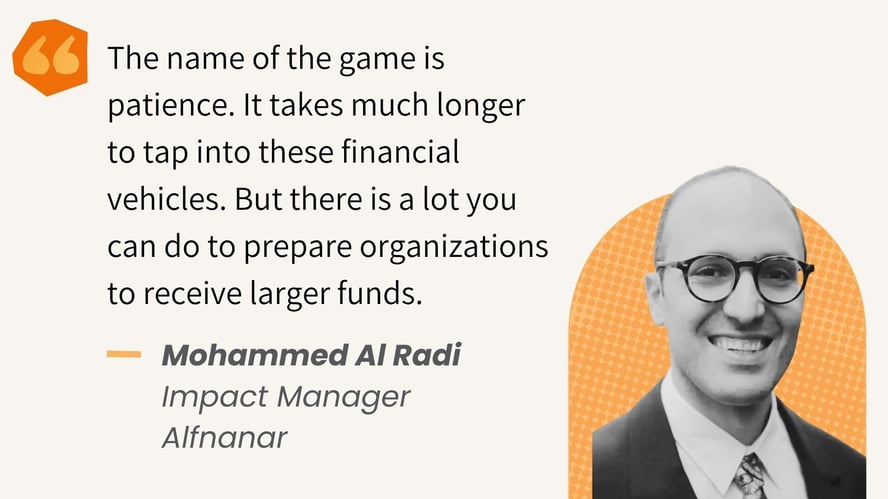
Impact investing aims to generate social and environmental returns in addition to financial returns. It includes a variety of social enterprise models which exist somewhere in the middle on the continuum between traditional non-profits, on one end, and businesses, on the other.
In the Global South, venture philanthropy—marked by the use of catalytic capital—tends to blend elements of grant-making and corporate finance. This type of support builds an organizations’ financial capacity and business acumen, especially in the early stages of their transition to a social enterprise.
Alfanar’s work focuses on this kind of investment readiness. There are an estimated 10,000 social enterprises in the Arab world, and Alfanar has worked with about 200 of them.
“What we’re doing is de-risking,” says Mohammed. “We’re staying with them for three to five years so that the impact investors are comfortable to go in and see there is a track record: they’ve taken zero-interest loans, they’ve constantly delivered on impact, they have solid financial reserves and forecasts for the future.”
3 things to know to get started with impact investing
1. Interested in catalytic capital? Assess whether your work is investible

If you wanted to be part of Alfanar’s portfolio, Mohammed would have two questions for you to assess whether your organization had the potential to scale:
- First, do you do something that is investible, like creating a product or service?
- Second, can you (or will you be able to) cover your costs?
If the answers are yes, you’re in good shape to receive catalytic capital.
Alfanar provides grants, zero-interest loans and, sometimes, takes an equity stake in partner organizations. It also provides high-engagement technical support over the course of 3-5 years. By the end of the first year, Alfanar will have helped its partners create a business plan. It also provides coaching and support related to impact measurement, legal requirements, good governance, quality control, financing, forecasting and other processes or strategies.
For example, EducateMe is an Egyptian partner that was able to generate income after opening a school in a low-income community. With Alfanar’s support, EducateMe offered their training services to schools across the country, whether public or private. The advocacy involved in this was so effective that the national government eventually contracted them as advisors.
“We saw that as a real success—they scaled nationally, and the government now consults them and engages them to train schools across the country,” explains Mohammed.
Not only did EducateMe gain policy influence, but the income from nationwide trainings now funds their work in low-income communities.
“For these under-staffed organizations, the loan is a real step up,” Mohammed says. “When they’re able to pay this off, it’s a revelation—they can now get other kinds of funding beyond grants and can look at other investors.”
2. Develop a business plan and onboard new skills—but beware “mission drift”

Take your time, advises Mohammed.
Ask yourself if you have the internal capacity to create a business plan. The plan should be clear about what you need to do to sell your product/service, scale your operation and communicate your impact.
Organizations set up as non-profits will likely need to operate differently to generate income. A change in legal set-up (registering a business, for example) might be needed to receive loans. Or, you might need to bring people with different skills and capacities on your team. This often means managing a culture shift around these new ways of working.
For example, BOT (Bridge, Outsource, Transform) is an organization that, when they began with Alfanar, focused on upskilling youth in Lebanon in the tech sector.
“We helped them create a business out of it and position Lebanon as a freelancer hub in the region, so that companies in the Gulf or Europe who wanted help with AI tasks or annotation, would hire from BOT. And BOT, in turn, would have a pool of thousands of youth with the skill to do that.”
Like BOT, let your mission lead the way. Avoid sacrificing your core purpose for the sake of winning funding.
“It’s not about how many grants you can collect but those that advance your mission,” warns Mohammed. “We see a lot of mission drift from NGOs accepting any kinds of grants. That’s why we typically work with organisations for three to five years in a focused way, avoiding distractions.”
And remember, blended business models are a great option.
“If you can at least cover fifty to sixty percent of your costs, you become a more resilient organization,” Mohammed reminds us.
3. Measure and report your impact

Key parts of the work include due diligence, ensuring adherence to standards, stakeholder engagement, and impact assurance. Alfanar offers support to their partners to develop their impact measurement and management systems because it’s vital that they gather more robust evidence than anecdotal data from their target communities or stakeholders.
“If you want funders, you need to prove that what you’re doing is contributing to social and environmental outcomes,” says Mohammed. “Our impact model is very rigorous. We check and cross-reference with the communities so that there’s real impact and we avoid green washing.”
This can be challenging because, unlike in the financial world where assessments are standardized, there are dozens of standards for impact measurement around the world. Being a relatively young field, these standards need time to mature.
Do your research and be clear about how you will measure, track and transparently disclose your impact—financially, environmentally and socially.
What’s next?
Impact investing is part of a wider trend asking companies and investors to respect (and disclose) environmental, social and governance standards—including recent pushes in stock exchanges in Jordan and Egypt.
There is so much potential, but without the right support to get started and scale, innovation can stagnate, which is why Alfanar’s impact readiness work is so important.
Alfanar’s impact helps inject fresh capital from outside traditional philanthropic and aid actors into Middle East and North Africa (MENA) communities. As more social-purpose organizations adopt the triple bottom line approach to business, the region as a whole benefits.
So, while the instability in the MENA region remains an obstacle to attracting investors, Mohammed, as ever, is patient.
“Alfanar, and other actors like us, are hoping to get social enterprises ready so that if, tomorrow, a giant pension fund says ‘we want to invest in ESG2 or impact investing compliant organizations’, that they’re ready to take that investment and scale their impact.”
The recently launched Anara Capital, an associated impact investing arm, plans to make big ticket (USD $0.5 million to $2 million) investments into impact-driven businesses and reinvest part of the dividends into Alfanar.
“What I’ve seen in the last five years is really inspirational,” says Mohammed, with an eye toward the future. “There’s definitely a wave coming.”
Notes
- This data, along with this blog, is based on conversations with Mohammed Al Radi of Alfanar in September 2025. One of these conversations were supported by the Ford Foundation’s BUILD program and the other was jointly hosted by Spring, Human Rights Funders Network, Solidaire and attended by a number of global social and climate justice funders for a discussion on how the philanthropic sector can respond to a post-aid world and nurture resilience financial models for civil society organizations. To learn more about our public-facing 2025 conversation series on this topic, visit our Reimagining Resilience Library.
- Environmental, social, and governance (ESG) investing.